Consensus Guidelines for Early Onset Sepsis (EOS) Screening & Management in Infants Greater Than or Equal to 34 weeks GA
Print | Back to Main Guidelines Listing
UCSF NCNC (Northern California Neonatology Consortium)
This work is licensed under a Creative Commons Attribution-Noncommercial 4.0 International License
Table of Contents
- Objective
- Screening and Initial Evaluation
- Lab Workup
- Management
- Disposition
- FAQ
- REFERENCES
- APPENDIX 1
- APPENDIX 2
Objective
This guideline provides standardized recommendations for evaluation and management of early-onset sepsis (EOS) in infants greater than or equal to 34 weeks’ gestation across NCNC sites. For infants greater than or equal to 35 weeks, management is guided by the 2024 Kaiser Neonatal Early-Onset Sepsis Calculator. For infants born 34 0/7–34 6/7 weeks, a hybrid risk-based approach is used.
Screening and Initial Evaluation
Infants Greater Than or Equal to 35 Weeks’ Gestational Age
- Who should be evaluated?
All infants greater than or equal to 35 weeks’ gestation with: - Maternal chorioamnionitis / intraamniotic infection
- Maternal fever greater than or equal to 38.0°C
- Prolonged rupture of membranes
- GBS colonization with inadequate intrapartum prophylaxis
- Concerning clinical signs
- Management Approach
Use the 2024 Kaiser Neonatal EOS Calculator:
https://neonatalsepsiscalculator.kaiserpermanente.org/ - Enter objective perinatal risk factors
- Use institutional baseline incidence (If you don’t know local incidence: 0.27/1000 births is the Kaiser-calculated incidence and a good approximation. To be more conservative, can use 0.5/1000)
- Follow calculator recommendation
Infants 34 0/7 – 34 6/7 Weeks Gestational Age: Hybrid Approach
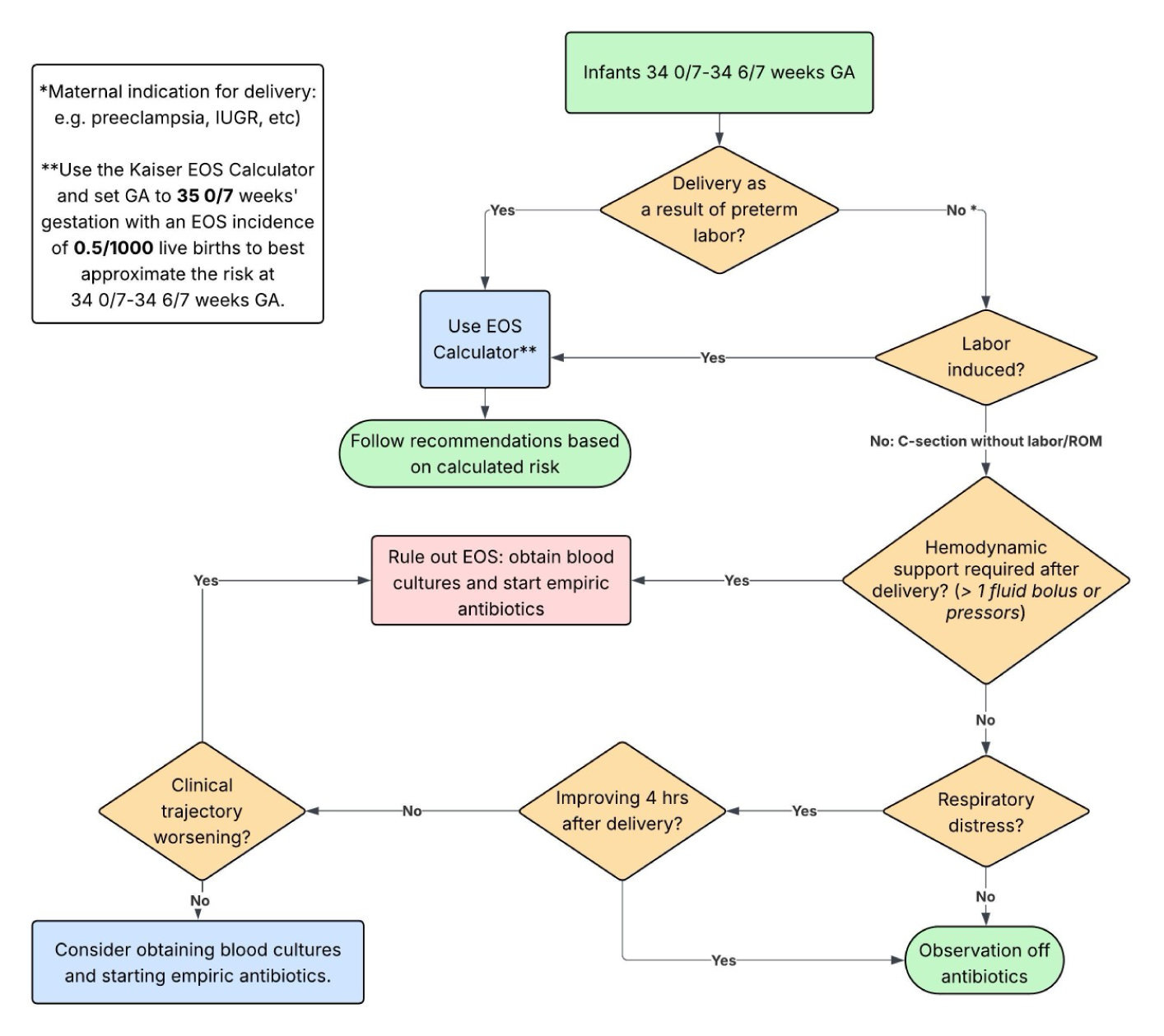
Because 34-week infants were not included in the updated EOS calculator model, management should follow a hybrid approach based on delivery context and clinical condition (See Appendix 2).
Preterm Labor and/or Rupture of Membranes: Use EOS Calculator.
If a 34-week infant is born following spontaneous preterm labor or rupture of membranes, use the EOS calculator to estimate sepsis risk and guide management. These infants have infectious exposure risk similar to those greater than or equal to 35 weeks’ gestation and should undergo calculator-based risk stratification.
To best approximate risk for infants at 34 0/7–34 6/7 weeks’ gestation, enter 35 0/7 weeks’ gestational age in the calculator with an EOS incidence of 0.5 per 1000 live births, providing a conservative estimate of risk.
Maternal Indication for Delivery (e.g., preeclampsia, IUGR)
- Labor induced: Use EOS Calculator
If labor was induced, use the EOS calculator (again using 35 0/7 weeks’ GA and 0.5/1000 incidence) to determine risk. Induction introduces labor-related exposure and should be managed similarly to other labor-associated deliveries.
- Cesarean delivery without labor or rupture of membranes : evaluation depends on clinical status of infant.
- Requires hemodynamic support, including more than one fluid bolus or pressors: evaluate and rule out EOS, including obtaining blood cultures and starting empiric antibiotics as clinically indicated.
- Does not require hemodynamic support: observation, without empiric antibiotics.
- Infants w/ respiratory distress > 4 hours after delivery: consider obtaining blood cultures and starting empiric antibiotics if clinical trajectory is worsening
Respiratory distress is common at 34 weeks’ gestation and should not automatically prompt empiric antibiotics in the absence of infectious risk factors. Gestational age alone does not mandate treatment. Delivery context and current clinical condition should guide EOS management in this population.
Lab Workup
Blood Culture
A blood culture should be obtained in any infant for whom empiric antibiotics are initiated.
In infants greater than or equal to 35 weeks, obtain blood culture according to EOS calculator recommendation or if clinically ill. In infants 34 0/7–34 6/7 weeks, obtain blood culture when empiric antibiotics are initiated based on clinical status or risk assessment as outlined above.
Collection
- Blood culture should be obtained via sterile peripheral venipuncture or newly placed umbilical catheter.
- A minimum of 1 mL of blood is recommended to optimize culture yield.
Timing
- Blood culture should be obtained prior to initiation of antibiotics whenever possible.
Lumbar Puncture (LP)
Lumbar puncture is not required routinely in the initial evaluation of early-onset sepsis.
Lumbar puncture should be considered in:
- Infants with clinical instability suggestive of sepsis
- Infants with positive blood culture
- Infants with persistent signs of infection despite antibiotic therapy
Lumbar puncture may be deferred in clinically unstable infants until stabilized. Consider Pediatric Infectious Disease Consult for Guidance.
CBC and Inflammatory Markers (CRP, I:T etc.)
Use of CBC, CRP, or immature-to-total neutrophil ratio (I:T) is not required for EOS risk stratification.
These tests are most useful in infants >= 4 hours old, with sepsis risk close to the calculator’s treatment threshold of 3/1000 (i.e., 1 to 6/1000). The risk of sepsis from the calculator can then be multiplied by the likelihood ratio for the ANC or (I/T2, if available; see appendix) to obtain a posttest probability estimate.
In infants already receiving empiric antibiotics, inflammatory markers may be used as adjunctive data but should not delay discontinuation of antibiotics at 24 hours if blood culture remains negative and the infant is clinically well.
Management
Antibiotic Choice
Empiric Therapy
- Ampicillin and Gentamicin
- Dosing information: https://idmp.ucsf.edu/neonatal-antimicrobial-dosing-benioff-childrens-hospitals
Definitive Therapy
- Modify antibiotic therapy based on organism identification and susceptibilities
- Pediatric Infectious Disease consultation is recommended
Treatment Duration
Rule-Out Sepsis (Culture Pending, Clinically Well)
- Timing is based on time of blood culture inoculation (time drawn)
- Discontinue antibiotics at 24 hours after blood culture inoculation if:
- Blood culture remains negative
- Infant is clinically well
- Additional antibiotic doses at the 24-hour time point are not required if culture remains negative
- Infant should not be discharged before 36–48 hours of age
Rule-Out Sepsis (Culture Pending, Respiratory Symptoms Present)
- If respiratory symptoms persist without evidence of bacterial infection (e.g., no pneumonia), discontinue antibiotics at 48 hours if:
- Blood culture remains negative
- Clinical course is improving
- If initial chest radiograph is abnormal but respiratory symptoms resolve by 24–48 hours, bacterial infection is unlikely
- Routine repeat chest radiograph is not required
Culture-Negative but Clinically Significant Illness
- Duration of therapy should be individualized based on clinical course
- A typical empiric treatment course is approximately 7 days
- Evidence guiding duration in culture-negative illness is limited
- Consider lumbar puncture if concern for central nervous system involvement
Culture-Positive Sepsis
- Duration of therapy should be based on organism, site of infection, and clinical course
- Pediatric Infectious Disease consultation is recommended
- If suspected contaminant: repeat blood culture, re-evaluate infant’s clinical status, continue antibiotics until organism speciation complete and proven negative follow-up culture x 24 hours (see Appendix 1 for common contaminants)
- Repeat blood culture is not routinely required in clinically improving infants with uncomplicated bacteremia
- Obtain repeat blood culture if:
- Persistent clinical instability
- Organisms associated with prolonged bacteremia
Disposition
Infants Not Receiving Antibiotics
- May be discharged per routine newborn criteria
- Serial clinical reassessment should be performed during the first 24 hours after birth
Infants Receiving Empiric Antibiotics (Culture Negative)
- Antibiotics may be discontinued at 24 hours after blood culture inoculation if:
- Blood culture remains negative
- Infant is clinically well
- Infant should not be discharged before 36–48 hours of age
Infants Receiving Antibiotics for Persistent Symptoms (Culture Negative)
- If antibiotics are continued to 48 hours for persistent respiratory symptoms, discontinue if:
- Blood culture remains negative and clinical course is improving
- Discharge once clinically stable and meeting routine newborn discharge criteria
Infants with Culture-Positive Sepsis
- Disposition and duration of hospitalization should be guided by:
- Identified organism
- Site of infection
- Clinical course
- Pediatric Infectious Disease consultation is recommended
HSV Considerations:
Maintain a low threshold to consider neonatal HSV in infants with risk factors (e.g., maternal HSV infection, especially primary or active lesions at delivery) or concerning clinical features (e.g., vesicular rash, seizures, transaminitis, or unexplained illness). Evaluate and initiate empiric acyclovir when indicated, in consultation with Pediatric Infectious Disease.
Transfer Considerations
Transfer to a tertiary or quaternary care center should be considered if any of the following are present:
- Persistent hemodynamic instability or concern for septic shock
- Escalating respiratory support beyond local capability
- Seizures or concern for central nervous system infection
- Persistent bacteremia or infection requiring subspecialty management beyond local resources
- Failure to improve despite appropriate therapy
Transfer decisions should be made in collaboration with the receiving center and Pediatric Infectious Disease when appropriate.
FAQ
What are the differences between version 1 (2017) and version 2 (2024) of the Kaiser Sepsis Calculator?
The EOS calculator was updated in 2024 to reflect contemporary birth data and current obstetric practices. The overall risk-based approach did not change, and clinical management recommendations remain similar to the prior version.
Key updates include:
- Updated dataset
- The model was recalibrated using contemporary U.S. birth data (2010–2020), replacing the original 1993–2007 cohort.
- Revised intrapartum antibiotic classification
- Only penicillin, ampicillin, or cefazolin are considered adequate GBS intrapartum antibiotic prophylaxis (IAP).
- Clindamycin and vancomycin are categorized as broad-spectrum antibiotics and are not considered effective GBS prophylaxis within the model.
- Alignment with universal GBS screening
- The updated model reflects current widespread maternal GBS screening practices. In settings without universal GBS screening, the prior version should be used.
- Similar clinical performance
- The updated model demonstrates slightly improved sensitivity for detecting early-onset sepsis, with minimal change in antibiotic recommendations.
Why are infants 34 0/7- 34 6/7 weeks GA not included in the 2024 update?
Although the original EOS calculator included infants greater than or equal to 34 weeks’ gestation, the 2024 recalibration was derived using data from infants greater than or equal to 35 weeks only.
Among 34-week infants, respiratory distress is common and limits the usefulness of clinical presentation as a discriminator for early-onset sepsis. In addition, many late preterm infants are admitted to the NICU primarily due to gestational age rather than infectious concern. Because their baseline clinical course and admission patterns differ from more mature infants, they were excluded from the updated cohort.
How are infants born at 34 weeks different?
Infants born at 34 weeks represent a small proportion of births but experience high rates of respiratory support and NICU admission. Despite frequent evaluation and antibiotic exposure, the incidence of early-onset sepsis in this population remains low.
Because respiratory symptoms are common at this gestational age and may not reflect infection, gestational age alone should not mandate empiric antibiotic treatment. Delivery context and overall clinical status should guide management.
How do I interpret the CBC from an EOS workup?
CBC indices—including total white blood cell count, absolute neutrophil count, and I:T ratio—have limited value for early-onset sepsis, particularly in the first hours after birth. If no band count is available, the likelihood ratios for ANC or WBC according to the infant’s age in hours at the time the CBC was drawn should be used. Multiply the risk of sepsis that incorporates the clinical exam shown in the calculator by the likelihood ratio to obtain an updated risk. If it is 1-2.9/1000, do a blood culture and q4h vital signs; if it is >= 3/1000 treat with empiric antibiotics.
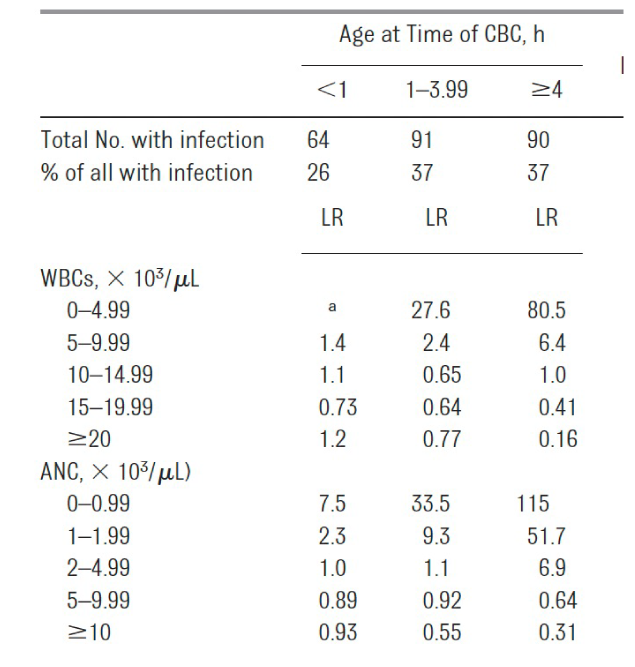
Routine use of CBCs, CRP, or procalcitonin as screening tests in well-appearing infants is not recommended. Although serial inflammatory markers may occasionally support decisions about discontinuing antibiotics in selected cases, clinical examination and the infant’s evolving condition remain the primary determinants of management.
References
Benitz WE, et al. 2015. Reappraisal of Guidelines for Management of Neonates with Suspected Early-Onset Sepsis. J Peds. 166,4: 1070-1074.
Brady MT, et al. 2013. Prevention and Management of Infants with Suspected or Proven Neonatal Sepsis. Pediatrics. 132: 166-168.
Escobar GJ, et al. 2014. Stratification of Risk of Early-Onset Sepsis in Newborns > 34 Weeks’ Gestation. Pediatrics. 133: 30-36.
Hornick CP, et al. 2012. Use of the Complete Blood Cell Count in Early-Onset Neonatal Sepsis. Pediatr Infect Dis J. 31: 799-802.
Newman TB, et al. 2010. Interpreting Complete Blood Counts Soon After Birth in Newborns at Risk for Sepsis. Pediatrics. 126: 903-9.
Newman TB, et al. 2014. Combining Immature and Total Neutrophil Counts to Predict Early Onset Sepsis in Term and Late Preterm Newborns: Use of the I/T2. Pediatr Infect Dis J. 33,8: 798-802.
Polin RA & COFN. 2012. Management of Neonates with Suspected or Proven Early-Onset Bacterial Sepsis. Pediatrics. 129: 1006-15.
Puopolo KM, et al. 2011. Estimating the Probability of Neonatal Early-Onset Infection on the Basis of Maternal Risk Factors. Pediatrics. 128: e1155-63.
Verani JR, et al. 2010. Prevention of Perinatal Group B Streptococcal Disease. Revised Guidelines from CDC, 2010. MMWR 59, RR-10.
Puopolo KM, et al. 2018. Management of Neonates Born at >= 35 0/7 Weeks’ Gestation With Suspected or Proven Early-Onset Bacterial Sepsis. Pediatrics 142: e20182894.
Puopolo KM, et al. 2018. Management of Neonates Born at <= 34 6/7 Weeks’ Gestation With Suspected or Proven Early-Onset Bacterial Sepsis. Pediatrics 142: e20182894.
Kuzniewicz MW, Puopolo KM, Wi S, et al. Update to the Neonatal Early-Onset Sepsis Risk Calculator Utilizing a Contemporary Birth Cohort. Pediatrics. 2024;154(4):e2023065267. doi:10.1542/peds.2023-065267
Flannery DD, Puopolo KM. Neonatal Early-Onset Sepsis: Epidemiology, Microbiology, and Controversies in Practice. Clin Perinatol. 2025;52(1):15-31. doi:10.1016/j.clp.2024.10.002
Appendix 1: Common Pathogens and Blood Culture Contaminants in Neonatal EOS Workup
Common Bacterial EOS Pathogens
Fungal Pathogens (Uncommon in greater than or equal to 34 Weeks)
Common Contaminants *
Group B Streptococcus (Streptococcus agalactiae)
Candida species
Coagulase-negative staphylococcus (i.e. S. epidermidis)
Other beta-hemolytic streptococci (rare)
Viridians streptococci
Escherichia coli
Corynebacterium species
Staphylococcus aureus
Bacillus species
Listeria monocytogenes
Lactobacillus species
Enterococcus species
Peptostreptococcus species
Klebsiella species
Aerococcus species
Enterobacter species
Citrobacter species
Haemophilus Influenzae
* All organisms may be pathogenic in the appropriate clinical context (e.g., prematurity, central line, multiple positive cultures, clinical instability).
Appendix 2: Infants 34 0/7 – 34 6/7 Weeks Gestational Age Early-Onset Sepsis Workup
Disclaimer
These clinical practice guidelines are based upon the evidence-based consensus opinions of consortium members affiliated with UCSF Benioff Children's Hospitals. They are intended to guide pediatric/neonatal providers, but do not substitute for individual clinical judgment. Evaluation and treatment of specific patients should be adapted based upon the unique conditions of each patient, family and clinical environment.
Northern California Neonatal Consortium. Originated 10/2014 .
Revised 9/2019, 4/2026
Approved by UCSF Pharmacy and Therapeutics Committee: 6/2026